I have a question about __ziplistDelete function as follows:
            /* When the tail contains more than one entry, we need to take
             * "nextdiff" in account as well. Otherwise, a change in the
             * size of prevlen doesn't have an effect on the *tail* offset. */
            zipEntry(p, &tail);
            if (p[tail.headersize+tail.len] != ZIP_END) {
                ZIPLIST_TAIL_OFFSET(zl) =
                   intrev32ifbe(intrev32ifbe(ZIPLIST_TAIL_OFFSET(zl))+nextdiff);
            }
As we know, ZIPLIST_TAIL_OFFSET macro returns the offset of the last item(entry) inside the ziplist. When the tail contians just one entry instead of more than one entry , should we take "nextdiff" in account as well? Is there a problem about these lines:
      if (p[tail.headersize+tail.len] != ZIP_END) {
                ZIPLIST_TAIL_OFFSET(zl) =
                   intrev32ifbe(intrev32ifbe(ZIPLIST_TAIL_OFFSET(zl))+nextdiff);
            }
Thanks.
/* Delete "num" entries, starting at "p". Returns pointer to the ziplist. */
unsigned char *__ziplistDelete(unsigned char *zl, unsigned char *p, unsigned int num) {
    unsigned int i, totlen, deleted = 0;
    size_t offset;
    int nextdiff = 0;
    zlentry first, tail;

    zipEntry(p, &first);
    for (i = 0; p[0] != ZIP_END && i < num; i++) {
        p += zipRawEntryLength(p);
        deleted++;
    }

    totlen = p-first.p; /* Bytes taken by the element(s) to delete. */
    if (totlen > 0) {
        if (p[0] != ZIP_END) {
            /* Storing `prevrawlen` in this entry may increase or decrease the
             * number of bytes required compare to the current `prevrawlen`.
             * There always is room to store this, because it was previously
             * stored by an entry that is now being deleted. */
            nextdiff = zipPrevLenByteDiff(p,first.prevrawlen);

            /* Note that there is always space when p jumps backward: if
             * the new previous entry is large, one of the deleted elements
             * had a 5 bytes prevlen header, so there is for sure at least
             * 5 bytes free and we need just 4. */
            p -= nextdiff;
            zipStorePrevEntryLength(p,first.prevrawlen);

            /* Update offset for tail */
            ZIPLIST_TAIL_OFFSET(zl) =
                intrev32ifbe(intrev32ifbe(ZIPLIST_TAIL_OFFSET(zl))-totlen);

            /* When the tail contains more than one entry, we need to take
             * "nextdiff" in account as well. Otherwise, a change in the
             * size of prevlen doesn't have an effect on the *tail* offset. */
            zipEntry(p, &tail);
            if (p[tail.headersize+tail.len] != ZIP_END) {
                ZIPLIST_TAIL_OFFSET(zl) =
                   intrev32ifbe(intrev32ifbe(ZIPLIST_TAIL_OFFSET(zl))+nextdiff);
            }

            /* Move tail to the front of the ziplist */
            memmove(first.p,p,
                intrev32ifbe(ZIPLIST_BYTES(zl))-(p-zl)-1);
        } else {
            /* The entire tail was deleted. No need to move memory. */
            ZIPLIST_TAIL_OFFSET(zl) =
                intrev32ifbe((first.p-zl)-first.prevrawlen);
        }

        /* Resize and update length */
        offset = first.p-zl;
        zl = ziplistResize(zl, intrev32ifbe(ZIPLIST_BYTES(zl))-totlen+nextdiff);
        ZIPLIST_INCR_LENGTH(zl,-deleted);
        p = zl+offset;

        /* When nextdiff != 0, the raw length of the next entry has changed, so
         * we need to cascade the update throughout the ziplist */
        if (nextdiff != 0)
            zl = __ziplistCascadeUpdate(zl,p);
    }
    return zl;
}
Comment From: Qinch
@soloestoy 麻烦帮忙看下我是否理解错误
Comment From: soloestoy
OK, I will check that. News come soon.
Comment From: soloestoy
Hi, @Qinch
It is not a bug, just remember that the ZIPLIST_TAIL_OFFSET points to the last zlentry, not the ZIP_END.
If the tail contains only one entry, the ZIPLIST_TAIL_OFFSET already points to the tail, so we need to take nextdiff in account only when the tail contains more than one entry, and __ziplistCascadeUpdate will work to update all entries in tail.
Comment From: Qinch
Thanks for you reply @soloestoy ,I know that ZIPLIST_TAIL_OFFSET return the head address of the last entry(最后一个zlentry的首地址) in zl.
I'm sorry for my broken English.
我想到的是这样一种场景(单击图片放大):
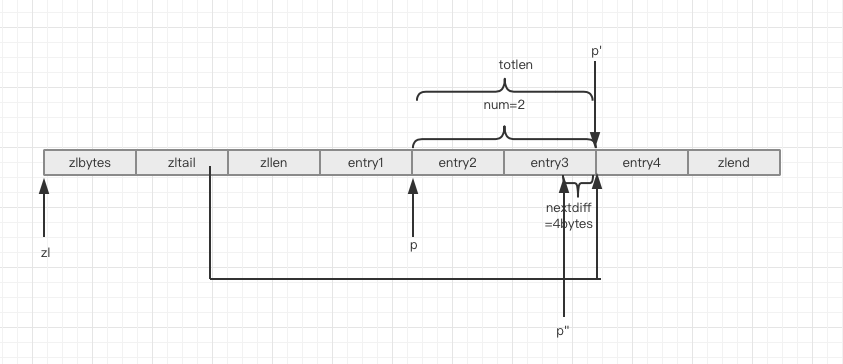
图中zl为ziplist的首地址,p为__ziplistDelete的参数,num=2,即表示从p开始删除两个entry。 在删除函数执行之前,其中entry2的prevlensize(即entry1的长度)采用5个bytes表示,而entry4的prevlensize(entry3的长度)为1个字节,所以nextdiff=4bytes 当删除函数执行时,zltail设置的值为 new zltail=old zltail-totlen, 如果tail指向的为last zlentry, new zltail指向的last zlentry的首地址的值应该为p'-nextdiff?
Comment From: soloestoy
OK, let me show the trace of this scenario:
    zipEntry(p, &first);
    for (i = 0; p[0] != ZIP_END && i < num; i++) {
        p += zipRawEntryLength(p);
        deleted++;
    }

    totlen = p-first.p; /* Bytes taken by the element(s) to delete. */
After this loop, p points to entry4, and totlen is the length of entry2 and entry3.
    if (totlen > 0) {
        if (p[0] != ZIP_END) {
            /* Storing `prevrawlen` in this entry may increase or decrease the
             * number of bytes required compare to the current `prevrawlen`.
             * There always is room to store this, because it was previously
             * stored by an entry that is now being deleted. */
            nextdiff = zipPrevLenByteDiff(p,first.prevrawlen);

            /* Note that there is always space when p jumps backward: if
             * the new previous entry is large, one of the deleted elements
             * had a 5 bytes prevlen header, so there is for sure at least
             * 5 bytes free and we need just 4. */
            p -= nextdiff;
            zipStorePrevEntryLength(p,first.prevrawlen);

            /* Update offset for tail */
            ZIPLIST_TAIL_OFFSET(zl) =
                intrev32ifbe(intrev32ifbe(ZIPLIST_TAIL_OFFSET(zl))-totlen);
We will take this branch because the two conditions are satisfied, and no matter what the nextdiff is, after ZIPLIST_TAIL_OFFSET(zl) = intrev32ifbe(intrev32ifbe(ZIPLIST_TAIL_OFFSET(zl))-totlen); the ZIPLIST_TAIL_OFFSET points to the address of entry2, the real tail.
            zipEntry(p, &tail);
            if (p[tail.headersize+tail.len] != ZIP_END) {
                ZIPLIST_TAIL_OFFSET(zl) =
                   intrev32ifbe(intrev32ifbe(ZIPLIST_TAIL_OFFSET(zl))+nextdiff);
            }
So, these code should not be executed, make sense?
Comment From: Qinch
谢谢,打扰了 @soloestoy
Comment From: soloestoy
u r welcome : )
Comment From: allan-ma
- zipEntry(p, &tail); This mean p point to the tail entry of ziplist? if it is, why? If I just delete entry2, I think p should point to entry3, not the tail of ziplist
@soloestoy