Hello!
I have a problem using SAML, when I have only 1 kubernetes pod, I can work normally, when I have 2 pods, SAML cannot perform authentication, it is lost.
One of this component's changes makes the backend Statefull, which is problematic because each of the 2 enhanced pods in Kubernetes has a different state.
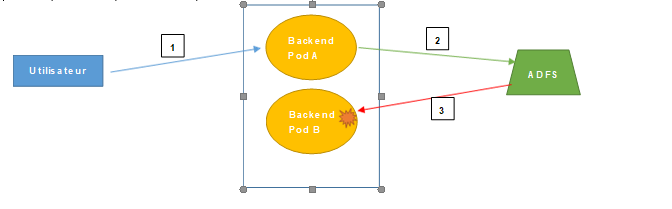
The situation is as follows:
Pod A receives an authentication request, stores the authentication request in memory, and makes the request to ADFS. The ADFS response is sent to pod B of the SATEBA backend, which does not have the request corresponding to the ADFS response.
What I try to do is:
Someone knows what I can do to solve this?
Thank you so much!
Comment From: marcusdacoregio
Hi @luissouza,
Based on the description, you are dealing with the problem of not having distributed sessions in a distributed environment.
By default, the SAML 2.0 Login support stores the SAMLRequest in the HttpSssion using HttpSessionSaml2AuthenticationRequestRepository. While the session exists in Pod A, it might not exist in Pod B because by default the session is handled by the servlet container and stored in memory.
You have a few options to solve this:
- Use sticky sessions to route the same request to the same pod
- Create a
Saml2AuthenticationRequestRepositorythat stores the request in a shared place, but this is not scalable. - And the recommended option: Use Spring Session to support clustered sessions without being tied to any application container.
All that said, I think this is not an issue in Spring Security but rather a question, therefore I'm closing this as answered.
Comment From: luissouza
Hi @luissouza,
Based on the description, you are dealing with the problem of not having distributed sessions in a distributed environment.
By default, the SAML 2.0 Login support stores the
SAMLRequestin theHttpSssionusingHttpSessionSaml2AuthenticationRequestRepository. While the session exists in Pod A, it might not exist in Pod B because by default the session is handled by the servlet container and stored in memory.You have a few options to solve this:
- Use sticky sessions to route the same request to the same pod
- Create a
Saml2AuthenticationRequestRepositorythat stores the request in a shared place, but this is not scalable.- And the recommended option: Use Spring Session to support clustered sessions without being tied to any application container.
All that said, I think this is not an issue in Spring Security but rather a question, therefore I'm closing this as answered.
Hey @marcusdacoregio thanks for your quickly answer! I will test and give to you a feedback here, thank you so much!